


Massachusetts Maritime Academy
Mass Maritime Receives Advanced Building Plaque for New Construction
Advanced Building Core Performance project earned $67,080 in incentives from Cape Light Compact. Depending on which direction you arrive from, the first thing you notice on Massachusetts Maritime Academy’s campus is either the hulking ship TS Kennedy, or the Academy’s 241 foot tall wind turbine. This presents an interesting duality in the school’s mission – training cadets in one of the oldest professions in the world while also preparing them with skills in fields that will allow them to be conscientious stewards of the earth in the 21st century.
The Details
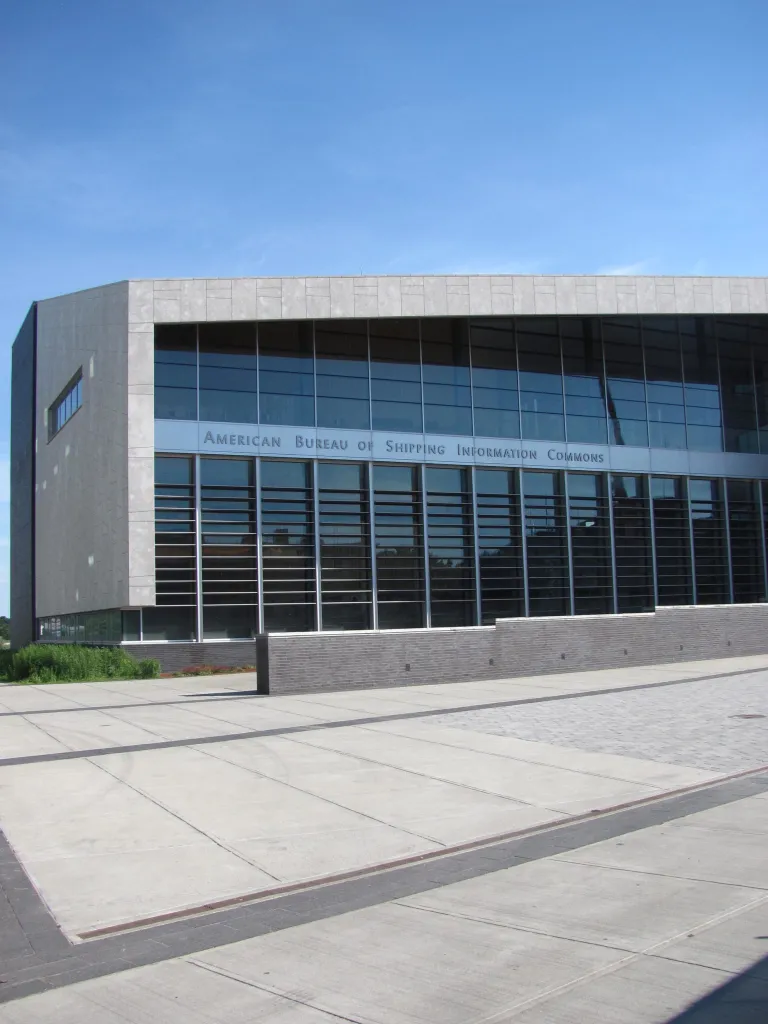
Sitting between the traditional and the cutting edge is the physical manifestation of this mission: the gleaming new American Bureau of Shipping Information Commons or, as it’s more commonly called, the library. The building houses student work areas, the Academy’s archives and museum, library and the 360-degree ship’s bridge simulator and classroom space. Completed in late 2011, the building incorporates the latest in energy efficient and sustainable construction practices, electrical systems, geothermal heating and cooling, waste and storm water management, reclaimed or recyclable furniture, passive solar design and ENERGY STAR® rated computers, appliances and fixtures.
The building attained LEED Silver Plus status upon completion, and has been steadily working towards becoming the first government owned building in the state to attain LEED Platinum status with the installation of photovoltaic solar panels on its sloped roof beginning
in 2013. This solar array will compliment the geothermal heating and cooling system already in place, taking the commons to near net-zero energy status. Even on a 38 degree day, the passive solar heating and day lighting is so efficient at warming the building that the geothermal system often runs in cooling mode even in the dead of winter. To date, the building has used only 565,169 kWh of electricity in 2012. So far, the building is operating 26% above the energy efficiency performance required by state code, making it a model for higher education and public entities nationwide.
A key part of the “Three E’s”
Mass Maritime’s curriculum is designed with a focus on the “Three E’s” – educational, ecological, and environmental education. The new commons building embodies all three as a “living laboratory” for cadets in the biological and engineering fields. Hands-on training and experiments are built into the curriculum, and many classes involve working with various features of the building’s energy and environmental management systems such as the 48 geothermal wells used to heat and cool the building, and examining plant growth and activity in the bioswale used to capture and purify storm water runoff. Operationally, this will result in an ongoing study of the best trimming plan for the area in winter months, and continued monitoring of the water quality released back into the Cape Cod Canal. Faculty input is actively solicited for any energy efficiency project on campus so that it can be integrated with their curricula from the very beginning, making energy efficiency a part of the cadets’ daily and academic lives.
Key Measures Implemented
- Passive solar design and ample day lighting
- Over 4,000 CFL and LED light bulbs, scheduled to switch to all-LED in 2013
- Geothermal heating and cooling – 48 – 400 foot wells on-site
- 100% radiant floor heating on the first floor
- Rapid renewable wood materials such as bamboo and maple used in building construction and furniture
- Fully computerized automated logic energy management system accessible via the internet and housed on-campus
- Louvers on exterior windows
- Occupancy sensors
- Recyclable furniture
- All building materials sourced within 600 miles of building site
- Rainwater retention and drainage in bioswale
- Building designed to minimize impact on MMA wind turbine operations
- Rooftop photovoltaic solar array to be installed in 2013

A lot of the energy savings in the building are the result of the high level of attention to detail paid to the project during the design and procurement phases. This is evident as soon as you see the building; the extensive use of day lighting, louvers and rapidly-renewable construction materials are all a big part of reducing the building’s environmental footprint.